Back to Home
VHF and UHF Filters
By Robert Meister WA1MIK (SK)
Currently Maintained by Mike Morris WA6ILQ.

|
Up one level (Antennas page) Back to Home |
Tests of DCI VHF and UHF Filters By Robert Meister WA1MIK (SK) Currently Maintained by Mike Morris WA6ILQ. |
|
CONTRIBUTIONS TO THIS PAGE ARE WELCOME!
Actually to any page at this web site!
Update early 2025 from the page maintainer:
Ralph Olds, the founder and owner of DCI decided to retire and sold the company about 8 years after this article was written in 2007. The new owners did not stick to Ralph's recipe and as a result developed serious quailty issues. After a while most of the distributors (example: AES and HRO) dropped the DCI products.
To fulfill the need for quality VHF and UHF filters Ralph started a new company, Olds Communications Inc. or OCI. The OCI web site appeared in 2016.
Ralph decided to retire (again) after 8 years and after trying to find a buyer for 6 months closed OCI in early 2025 and the web site evaporated soon after.
You can find an old snapshot at the wayback machine (archive.org).
If anyone would like to create an addendum to this page with information or plots of any other DCI / OCI filters like the 146-6H, 8H or 10H or a 222 MHz filter we'd be happy to add another DCI or OCI article.
If anyone knows of a company similar to OCI that makes bandpass filters we'd be happy to add a new manufaturer page to this web site.
DCI (Digital Communications Inc.) of Canada manufactures all sorts of low-pass, band-pass, and high-pass filters for commercial and amateur use. This article will show the performance of the DCI-146-4H VHF and DCI-445-10C UHF filters. DCI also makes filters in the 222 MHz range to order and custom filters anywhere in the 50 MHz to 900 MHz range.
Product Description:
Each unit contains four poles or sections (that's the smallest configuration DCI makes) and the list price is about $170US. DCI also has filters with six, eight, and ten poles that have significantly sharper out-of-band attenuation and a higher cost. None of the filters I own have mounting holes or tabs; they're designed to sit on top of something else. However, there are rack mounting panels and retrofit mounting kits available. The VHF filters come with UHF-female connectors while the UHF filters come with N-female connectors. The company will make any filter configuration you ask for.
Test Configuration:
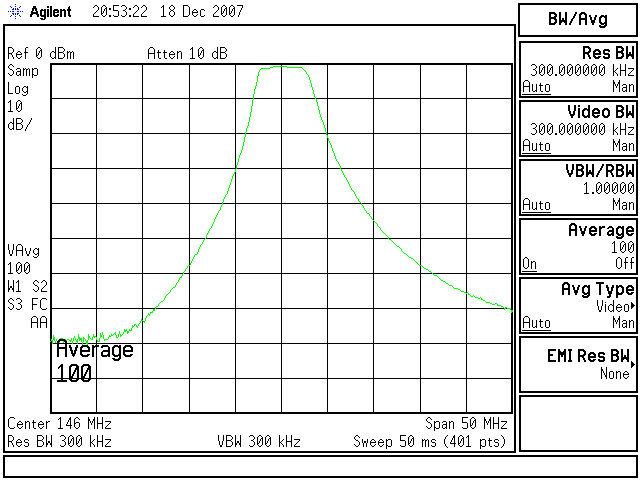
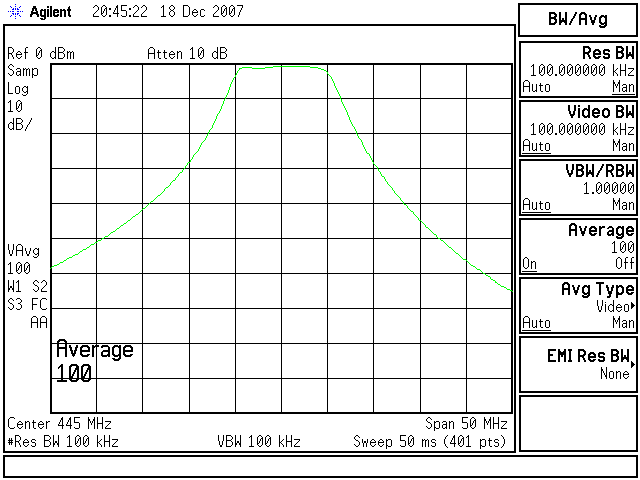
An Agilent E4401B 1.5 GHz spectrum analyzer was used to capture the waveforms. RG214 coax cables with crimped-on N-male connectors were used to attach the filters to the analyzer. N-female to UHF-male adapters were used for testing the VHF filter. The cables, connectors, and adapters had 0.27dB loss at 146 MHz and 0.35dB loss at 445 MHz. This loss has been taken into account in the measured data above.
The factory specifications shown below were obtained directly from text and graphs in the DCI product brochure PDF files. Bandwidths and frequencies are in MHz. Attenuations are in dB.
| Measurement Parameter |
Factory Specifications |
Measured | ||
|---|---|---|---|---|
| VHF | UHF | VHF | UHF | |
| Center Frequency | 146 | 445 | 146.3 | 445.0 |
| Total Bandwidth | 4 | 10 | 5.7 | 12.5 |
| Low Frequency | 144 | 440 | 143.5 | 439.0 |
| High Frequency | 148 | 450 | 149.2 | 451.5 |
| Pass-band Loss [1] | 0.42 | 0.29 | 0.30 | 0.20 |
| 3dB Bandwidth | ±2.6 | ±7.2 | ±2.7 | ±5.0 |
| 30dB Bandwidth [2] | ±5.7 | ±16.0 | ±6.0 | ±11.0 |
| 50dB Bandwidth [2] | ±10.2 | ±26.0 | ±10.0 | ±18.0 |
Here's the spectrum analyzer trace showing the full response of the VHF filter. There were other peaks periodically up the band, above 450 MHz.
The spec sheet for this VHF filter can be viewed as a 120kb PDF file here.
Here's the spectrum analyzer trace showing the full response of the UHF filter. There was another peak at approximately 1350 MHz.
The spec sheet for this UHF filter can be viewed as a 110kb PDF file here.
DCI makes 4, 6, 8, and 10 pole filters on both the 150 and 450 MHz bands. For comparison, I checked the graphs of filters tuned to 146 MHz with a 4 MHz bandwidth. Here's the attenuation of a signal at 150 MHz:
4-pole: 20dB; 6-pole: 35dB; 8-pole: 32dB; 10-pole: 72dB.
I also checked the graphs of filters tuned to 445 MHz with a 10 MHz bandwidth. Here's the attenuation of a signal at 455 MHz:
4-pole: 17dB; 6-pole: 38dB; 8-pole: 64dB; 10-pole: 80dB.
All of these graphs are viewable on DCI's web site.
Summary:
These two DCI filters, along with a Comet VHF / UHF diplexer, are in use with a dual-band mobile radio (used as a base station) at my home. I live about 3000 ft (900+ m) from a high-level RF site with dozens of paging, two-way, and trunking system transmitters on it. In particular, there's one paging system on 454.450 MHz, which is exactly 10 MHz above my UHF repeater's output frequency. When I talk on my handheld radios, transmitting on 449.450 MHz, that signal mixes with the paging system's 454.450 signal, and the 5 MHz difference causes all sorts of intermod on 444.450 MHz. Once I added the DCI filter in line with the antenna, ALL of the problems went away. Quietness has been retained. As these filters can handle 200 watts of power, they can be used on repeater transmitters, especially those that have built-in circulators which must be followed by filters of some sort.
These products meet or exceed every published specification. This is an unbiased opinion based on actual measurements and experience using the units. They are highly recommended.

|
ARRL Product Review from September 2017 QST (local copy of the 1.5 MB PDF, opens in a new browser tab). |
|
|
Two pages of reviews from the eHam web site (off-site pointer, opens in a new browser tab) |
A relevant contribution from Mike Morris WA6ILQ:
The Cal Tech Amateur Radio Club W6UE has a UHF repeater that is co-located
at a site in Pasadena California that also has a number of city, county, state and
federal public safety systems from 42 MHz to 900 MHz.
The W6UE repeater is a stock 100 watt MASTR II (with the factory
preamp option) and uses a conventional antenna system consisting of a PD-526
duplexer, 7/8 Heliax feedline and a 10 dB fiberglass antenna. It has been
in place at that site for over 30 years. The PD-526 is a wonderful duplexer
with one unfortunate characteristic: it has insufficient reject performance for
signals outside of it's range.
The MASTR II receiver developed a bad case of indigestion when a public
safety agency on 470 MHz moved in and put it's antenna near the W6UE
antenna.
A DCI 445-10 filter (10 MHz wide centered on 445 MHz) was
added between the duplexer and the antenna feedline (the filter can handle
200 watts). The DCI filter had less than 0.4 dB of insertion loss
and the 470 MHz signals were reduced by over 50 dB.
The DCI filter completely solved the interference issue.
Contact Information:
The original author is no longer with us (a silent key) as of June 2021. The current page maintainer can be contacted by way of the "Currently Maintained by" link above.
Back to the top of the page
Up one level
Back to Home
This page originally posted 18-Dec-07.
Original article text, graphics, and hand-coded HTML © Copyright 2007
by Robert W. Meister WA1MIK.
This web page, this web site, the information presented in and on its pages and in these modifications and conversions is © Copyrighted 1995 and (date of last update) by Kevin Custer W3KKC and multiple originating authors. All Rights Reserved, including that of paper and web publication elsewhere.