Click here to jump down on this page to the Midland Amateur Radio products (all are discontinued and no longer supported)
CONTRIBUTIONS TO THIS PAGE ARE WELCOME!
Actually to any page at this web site!
Midland Land Mobile Radio (LMR/Commercial) Products
I know nothing about this equipment so please don't ask!
The Midland commercial repeaters, mobiles and portables are showing up
in the used market in increasing larger quantities. Repeater-builder.com is
looking for information on the various models and would like to have someone
supply an overiew of the products - i.e. just what is a Syntech, or an XTR,
or a 70-045, or a 70-342, or a 70-7030, or a 70-565, or a 70-1340B? We have
a model chart below, but it's short on overview information - what makes one
particular model better over another (maybe a better front end)? We'd like to
present some combination of:
- How to read a model number - i.e. what the differences are between the various models
- Frequency ranges and which ones are crystal or synthesized
- What makes one particular model better over another (i.e. which ones are the turkeys)
- What it takes to move them onto amateur radio frequencies
- If they aren't crystal controlled, information on how to program them (i.e. hardware
programmer, PC program or front panel programming) would be appreciated, as well as
what PC software do you need (and how to get it)
- Information on any "gotcha's" (i.e. you can't get the PA transistors for a model XXX,
or a model YYY needs DOS-based software to program where a model ZZZ uses Windows-based
software) etc.
Midland Commercial Equipment
There is a Groups.io email list for almost every brand of radio, and Midland is no different.
Click here to go to the Midland LMR email list
(Off-site pointer, opens in a new browser tab).
One rule of thumb: The Syntech I radios use EPROM Modules and a proprietary hardware programmer,
while both the Syntech II and XTR radios program with a PC, like modern radios.
Anyone what to write an article on PC programming the Midland radios including the information on which models use which software?

|
Summarized from a posting on the Midland group at groups.io from Terry WA7LGY:
The six pin microphone connector that is used on some of the Midland radios has a peculiar pin configuration and I've not been able to find a source of the plugs. There are six pins, but they are not evenly spaced. One is off by about half a step.
Anybody able to provide a photo of the socket and a plug? Anyone have a source?
|

|
Installation and Setup Tips for the Midland 70-1488W-CD
Windows Programming Software By Sean Smock KC1IJS
For the XTR and SynTech II Mobiles. Does not apply to the DOS software.
|
|
|
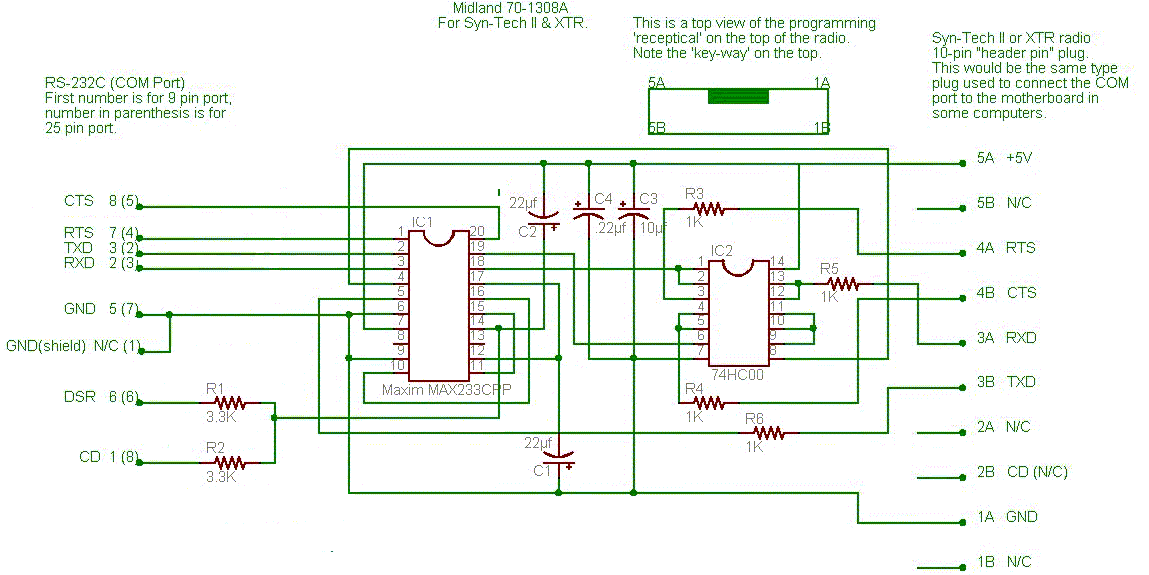
Here's the factory writeup of the 70-1308A programming cable – it uses a DB-25 on the computer end (since that was the PC serial port / COM port connector of the day). Midland no longer offers this cable. If anyone makes an aftermarket cable and would like a mention of it here then just let the mage maintainer know.
Hombrew 70-1308A Programmer – Here's the schematic
of a Syntech II and XTR programmer courtesy of Brett Kitchens KF4SQB
Unfortunately the pinout and wiring of the MAX233 IC as shown is incorrect.
There is another 70-1308A programmer diagram on the web, based on the MAX232 IC,
and it's just as incorrect.
|
|
|
Here's the schematic of another 70-1308A programming cable courtesy of YO4HFU – and it is correct and it works!
The 70-1309 cable uses the same circuit except with an RJ-45 connector to match the Bantam and Titan series
of radios and you should be able to make an adaptor or change the connector to work with the Syntech II.
|
|
|
Does anyone have any information on the Midland Programming Interface 70-1052A?
It is used to program the 70-045 / 70-065 / 70-165 / 70-265 / 70-166 / 70-266 series portables.
Or of the 70-1080 series Programmer ?
|
|
|
Midland Base, Repeater and Mobile model table
courtesy of Bill Janes, N9SII
|
|
|
Midland Portable model table courtesy
of Michael James KC5JDG
|
|
|
The Midland 70-201BD radio is a relabeled Maxon SD-125 UHF.
|
|
|
70-336 eight channel VHF Syntech I Schematic 2.6 MB PDF file
Donated by Mark N1MG
|
|
|
The Midland LMR Syntech 1 were made from 1984-1990. They are programmable, 80 channels and 50-100 watts depending on the model. Programming requires the stand alone 70-1000 programmer. The low band models cover 42-54 MHz (yes, they include the 6 meter band straight from the factory with NO modifications). The 50 watt models are 70-050C for front mount and the 70-055C is trunk mount (sometimes referred to as "remote mount"). The 100 watt versions are the 70-052C front mount and 70-056C trunk mount. Receive sensitivity is rated as .12 uv for 12 db of quieting.
Anyone know of a homebrew replacement for the 70-1000 programmer??? There is some information here:
https://brinkleyelectronics.com/prog/mid/midtech.htm.
|
|
|
70-340A/B and 70-440A/B Syn-Tech 20-40 Watt VHF-HI Mobile
Transceiver Service Manual 8.8 MB PDF file
The actual manual number is 70-136174 dated 10/82
|
|
|
70-0351A/B/C and 70-0355A/B/C 60 Watts VHF-LO Mobile Transceiver Manual 3.0 MB PDF file
The actual manual number is 70-351355 dated 7/91
|
|
|
70-0371A/B/C and 70-0375A/B/C Syn-Tech
XTR 110 Watt VHF-LO Mobile Transceiver Manual 5.1 MB PDF file
The actual manual number is 70-371375 dated 7/91, contributed by Randy W3RWN
|
|
|
70-1336A/B 15/30 Watt VHF-HI Mobile Transceiver
Manual 2.7 MB PDF file
The actual manual number is 70-133600 dated 4/91
|
|
|
70-1340A/B and 70-1440A/B 2-40 Watt VHF-HI
Mobile Transceiver Manual 4.7 MB PDF file
The actual manual number is 70-134144 dated 12/94
|
|
|
70-1395A/B and 70-1495A/B
2-110 Watt VHF-HI Mobile Transceiver Service Manual 4.5 MB PDF file
The actual manual number is 70-139149 dated 7/93
|
|
|
70-2103A and 70-2104A DTMF Mobile
Microphones 341 kB PDF file
Scanned by Dave K7QT
|
|
|
70-2914 CTCSS / CDCSS Encoder for the Syn-Tech II
70-3400AD/BD and 70-5300AD/BD 2.1 MB PDF file
This kit also adds a timeout timer, carrier delay timer, courtesy beep and high-pass audio filter to prevent
retransmission of the incoming CTCSS tone or CDCSS digital code.
The actual board number is 70-07519.
The actual manual number is 70-999936 dated 9/92
|
|
|
70-3400 and 70-3800 Syn-Tech II
40-watt and 110-watt VHF-HI Radio Service Manual 4.1 MB PDF file
The actual manual number is 70-340381, date unknown. This is part 1 of a 3‑manual set and
contains info about Accessories/Options/Models, Programming, Installation, and Repairs.
The programming portion of this manual specifies the 70-1080 Programmer, 70‑1081 Cloning
cable (to copy one radio to another) and does not mantion any PC programming cable or
software. Anyone know what cable and software is required?
|
|
|
70-3400 and 70-3800 Syn-Tech II
40-watt and 110-watt VHF-HI Radio Service Manual 2.4 MB PDF file
The actual manual number is 70-340383, date unknown. This is part 2 of a 3‑manual
set and contains information about the Deluxe Control Heads.
|
|
|
70-3400 and 70-3800 Syn-Tech II
40-watt and 110-watt VHF-HI Radio Service Manual 11.7 MB PDF file
The actual manual number is 70-340380, date unknown. This is part 3 of a 3‑manual
set and contains information about the TX / RX units.
|
|
|
70-3400AD/BD and 70-5300AD/BD
Syn-Tech II Duplex Mobile/Base/Repeater for VHF-HI or UHF band 4.9 MB PDF file
The actual manual number is 70-340530 dated 1/93
|
|
|
70-530A/B/C/D/E and 70-653A/B/C/D/E
Syn‑Tech UHF Mobile Radio Service Manual 3.9 MB PDF file
Actual manual number 70-406512 dated 3/83
|
|
|
Complete Service Information for the Syn‑Tech III
P25 STP-105B VHF Portable and STP-404(A)(B) UHF Portable 4.92 MB PDF file
|
|
|
"Service Manual Addendum" for the Midland 91-1060 to 91-1110 and 91-4050 to 91-4100 models 4.32 MB PDF file courtesy of Jerry Haaland, AE7VB
This manual is Part Number: 680-100-2049, Revision A, 1/2012 , and is for a Base Tech III model that is available in VHF or UHF, supports FM and P25.
VHF Bands: (MHz) "A"=136-156 MHz, "B"=146-174 MHz
UHF Bands: (MHz) "A"=400-435 MHz, "B"=440-475 MHz, "C"=465-500 MHz, "D"=485-520 MHz.
|
|
|
70-2187 Wide Band Modification 1.11 MB PDF
Applies to model 70-050, 70-052, 70-055, 70-056, 70-058, 70-060, 70-066, 70-076, 70-340, 70-380, 70-440, 70-480, 70-840, 70-530, 70-565, 70-630, 70-665 and 70-930.
This "wideband" modification has nothing to do with deviation. It simply expands the PLL lockup range and therefore expands the
performance bandwidth. It does not expand the receiver or transmitter tuning limits.
For example, the receiver VCO in the 70-530, 70-565, 70-630, 70-665 and 70-930 models had 5 MHz of lock-up wide and with the mod that
expands to 10 MHz. The transmitter went from 8 MHz to 15 MHz.
The circuit board part number is 70-075069 and is comprised of one resistor, one capacitor, one transistor and one zener diode and the components
could easily be added to the main circuit board in the radio. The circuit is a voltage regulator that sources both synthesizer VCO steering voltage driver
stages with 11 volts instead of 8 volts.
|
The Midland Base-Tech series (possibly the entire product line) is made in Japan by
Hitachi. These are crystal-controlled stations. Jeff AL1Q donated this two-manual set
for the 50 and 100 watt UHF base/repeater stations, which cover the UHF band in two
splits. The manuals were scanned, cleaned up, and stitched together by Bob WA1MIK. The
first part had color X-ray views; the second part was obviously a reprint and the X-ray
views were already in gray-scale. Both parts were scanned in gray-scale.
|
|
Base-Tech UHF Service Manual
part 1 6.5 MB PDF file
This contains the operating and installation information plus service information for
the non-frequency dependent equipment which is common to the entire Base-Tech line,
such as the control circuitry, power supply, and cabinet. 10/88 revision.
|
|
|
Base-Tech UHF Service Manual
part 2 25.4 MB PDF file
This contains specifications, troubleshooting procedures, technical data, and drawings
for the transmitter, receiver, and RF power amplifiers of the 71-4050 (50 watt UHF)
and 71-4120 (120 watt UHF) stations. 7/94 revision.
|
The Midland / Icom relationship:
The Midland 70-154A and B handheld are clones of the Icom H16 (16 channel
high band, front panel programmable) and are identical except for the color of the
plastic and the name on the housing. The 70-254A and B are clones of the U16, the UHF
version. The programming instructions for the H16 and U16 that are on
the Icom page at this web site will work for
the Midland clones.
The following information came from Chris Baldwin KF6AJM:
The Base Tech II and III series base stations and repeaters are OEM'd by Kyodo-West in
Japan. The rumor mill says that when the recent tsunami hit Japan, the Kyodo-West
factory was destroyed. Prior to the ICOM takeover, units were also manufactured
with "Securicor" branding, as well as a few other obscure brands, most likely for
overseas service. ICOM now manufactures the Base Tech III stations as the FR-9010
(VHF 110W) and RF-9020 (UHF 110W) P25 stations.
The Base Tech II is an analog-only station, available in VHF-Low, VHF-High, and UHF
in multiple band splits and power output levels. The Base Tech II has a light gray
front panel with an orange "SHIFT" key.
The Base Tech III is a dual mode analog/P25 station, available in VHF-High and UHF
in multiple band splits and power output levels. The Base Tech III has a dark gray
front panel with a teal "SHIFT" key.
Both are extremely well-built, well-designed, attractive radios. Full LCD display
and keypad make local control easy. Remote control is easy via interface to a fully
documented DB25 connector. Both are programmed using Windows software (which runs
in Windows 7 just fine), and I personally use a Midland factory USB-to-TTL converter
that uses an FTDI chip.
Midland band splits for VHF and UHF Base Tech II & III stations are as follows:
VHF "A": 136-156 MHz
VHF "B": 146-174 MHz
UHF "A": 400-435 MHz
UHF "B": 440-475 MHz
UHF "C": 465-500 MHz
Base Tech II product prefix is 71, Base Tech III product prefix is 91.
71-0110 = Base Tech II Lowband 110W
71-3050A = Base Tech II VHF 50 Watt 136-156 MHz
71-4110B = Base Tech II UHF 110 Watt 440-475 MHz
91-1110B = Base Tech III VHF 110 Watt 146-174 MHz
And so on.
Modules can be swapped around to create cross-band stations, at least with the Base
Tech II. I've seen it. Some units come with the 71-8885 options housing, which
depending on the housing model can contain a power supply with or without charger,
a tone remote adapter, etc.
The stations can slide around in bandwidth within reason. A VHF "B" station *should*
work down to 144MHz reasonably, it may or may not require a VCO adjustment. The nice
thing is that the stations are available within the amateur bands on VHF, UHF-Low and
UHF-Mid.
Midland Amateur Radio Equipment
Since Midland is out of the amateur radio market, and no longer offers any amateur
radio equipment manuals for sale, if someone can PDF the service manuals for these older
radios it would be appreciated. The models that we do not have include the 13‑505 mobile
(2 meter crystal controlled) and all of their amateur handhelds.
All of the amateur market Midland radios were carrier squelch only, but they had a
three pin or four pin accessory connector on the rear of the radio, and the signals available
included switched +12 volts DC on transmit, transmitter modulator audio in
and PTT in. Models with the four pin connector added receiver audio on pin 4.
A common modification was to replace the 3 pin rear accesory connector with a four
pin or a five pin (or more) DIN connector. Some folks used the connector for
powering DTMF encoders, some for CTCSS encoders, some (like the author) for both.
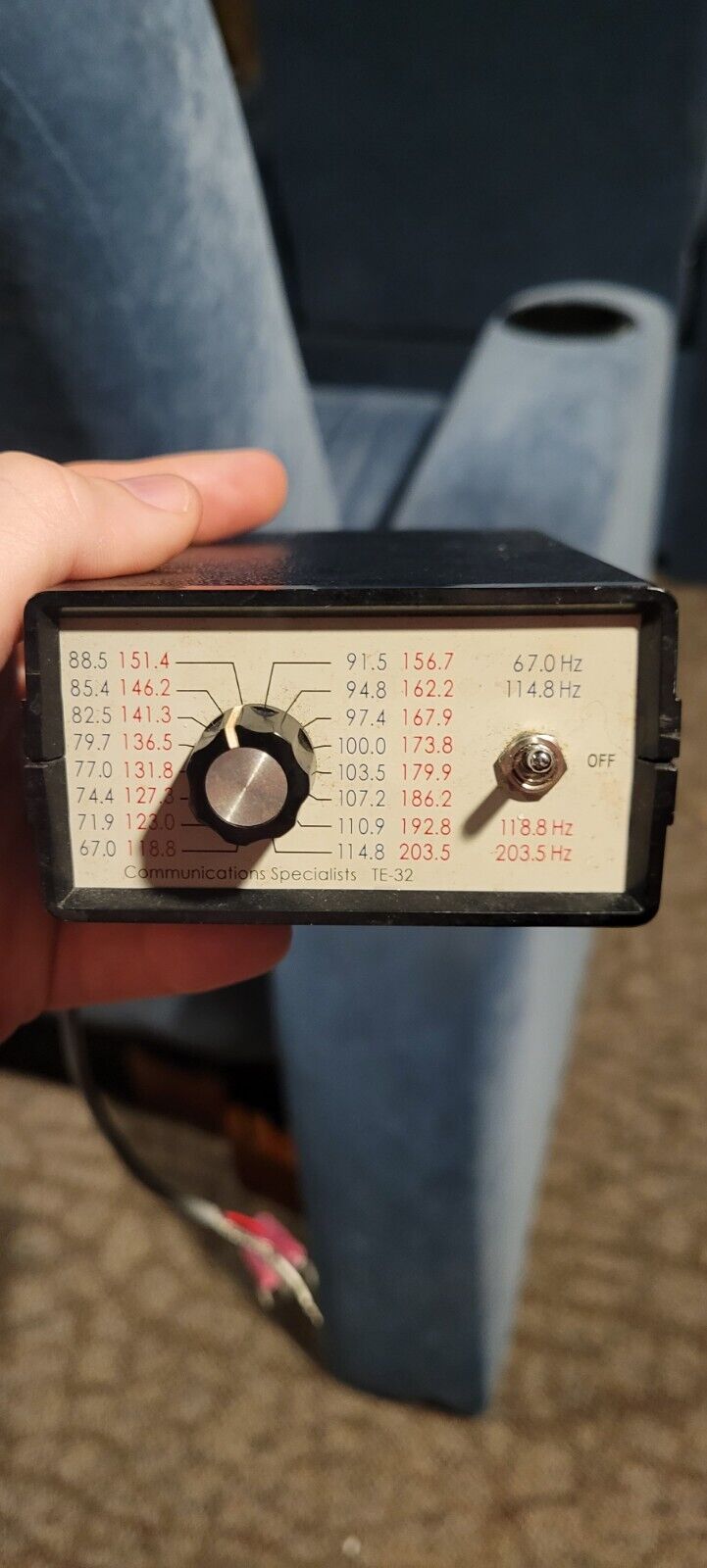
The most common CTCSS encoder used was made by Communications Specialists,
commonly known as Com-Spec, and they have their
own page at this web site. Adding a TS-32 allowed PL encode and decode on any of
the Midland amateur mobile radios.
The stock accessory connector connections had pin 1 to microphone audio, pin 2 to
audio ground, pin 3 to +12 on transmit, and models with a 4-pin connector had receiver
audio on pin 4.
In my mobile I disconnected the wire connected pin 4 and taped it off. I connected a
piece of RG-174 mini-coax to pin 4 and pin 2, ran it back to the transmitter
module, to a 100k resistor and then conencted the other end of the resistor to the base of TR28.
I then connected an external 16-button DTMF encoder to pins 1 and 2 and a CTCSS tone
encoder to pins 2, 3 and 4. I initally used a model TS-1, then added a rotary switch
and additional tone elements, then switched to a
TE-32 and later upgraded to a TD-64
just for the display. I later upgraded the 13‑509 to a 13‑513 and moved the TD-64
to that radio.
|
|
13‑500 User's Manual 5.1 MB PDF file
donated by Neil Swartz WA2EGE
A second donation of the same manual was received a few days later from Bernard
Socha KB3YWW.
The 13‑500 was a two meter version of the blackface 13‑509 twelve channel crystal
controlled 220 MHz mobile radio, offering 15 watts (the reality was 10) or
1 watt output.
This file is a PDF of the manual that was shipped with the radio. The schematic is inside the
back cover. Neil reports that as of December 2023 his 13‑500 is still in service.
|
|
|
The Midland 13‑505 was a 2m crystal radio 144-148 MHz with separate channel select switches
for receive and transmit. We don't have a good photo or the manual; anybody want to take a picture or two
and email them to us? We'd also like a scan of the manual or the loan of one for scanning.
|
|
|
13‑509 User's Manual 5.1 MB
PDF file donated by Ray Wolfe K9RI
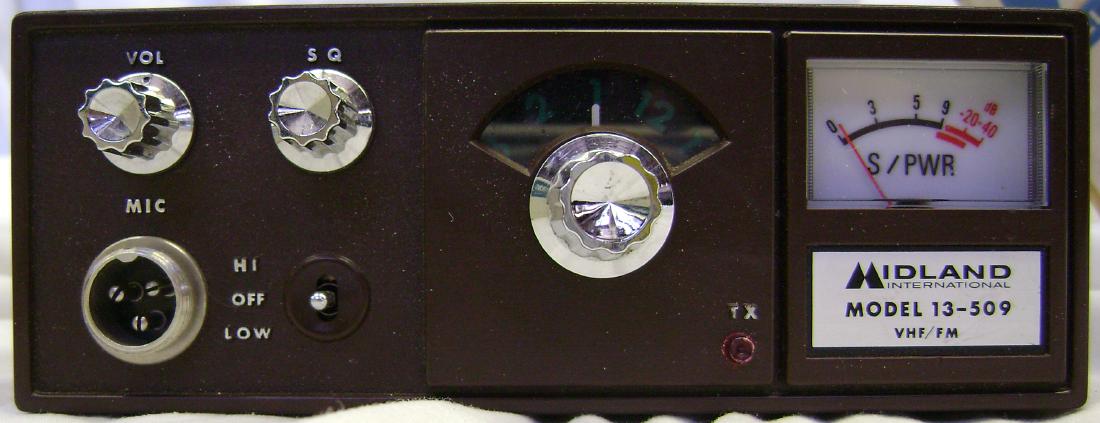
front panel photo
This radio is a 220 MHz version of the 13‑500, and was also marketed as the
Clegg FM-76 and Cobra Model 200 (both with cosmetically different front panels).
This file is a PDF of the manual that was shipped with the radio. The schematic is
inside the back cover. The Midland branded units were made with three different colors
of front panel: initially black, then tan and then chocolate brown (shown in the front
panel photo above). There were some slight component value changes between the
vintages / colors (anybody have that info?).
|
|
|
13‑509 Service Manual 1.7 MB PDF
file donated by Eric Lemmon WB6FLY
This is the manual that was sold by Midland as a service manual... for two dollars plus postage.
Yes, this file is smaller than the owner's manual, but that is due to a better scan and better
compression.
|
|
|
Notes on a repeater based on the Midland 13‑509
1.9 MB PDF file by Chuck Adams WB5WRR
|
|
|
Midland Radio Conversions
for Links and Repeaters by Karl Shoemaker AK2O of the Spokane Repeater
Group (http://www.srgclub.org) (offsite link)
(local copy just in case Karl's page goes away)
While Karl's web page is oriented to the 220 MHz Midland 13‑509 radio much of the
information is applicable to the 2 meter 13‑500 radio as well. The theory and comments are
well worth reading.
|
|
|
Preserve Your Sanity With This Midland 13‑509 Mod
By Wayne Rankin WA6MPG (From 73 Magazine for November 1979)
A simple modification (one resistor and one diode) that kills the squelch crash when switching from
transmit to receive. This mod is also applicable to the Clegg and Cobra versions of the 13‑509 radios
and to the 13‑500 2 meter version.
|
|
|
Improved Squelch Action for the 13‑500 or 13‑509
Donated by Bob Dengler NO6B
A simple modification (two caps and 1 resistor) that results in much better squelch action on
these radios. This mod is also applicable to the 13‑500 2 meter version.
|
|
|
5 watt Low-power Setting for 13‑509 and its
variants Donated by Larry Clore WB9F
A simple modification for changing the low power setting from 1 watt to 5 watts for point-to-point
link duty on the 13‑509 and its variants.
|
|
|
The 13‑510 was a synthesized 30 watt mobile that covered the full two meter band,
144-148 MHz. The 13‑513 was the same design except for 220-225 MHz.
Both had large internal speakers (perfect for mobile service) and much better receivers than their
13‑500 and 13‑509 predecessors.
The MHz selection was a multi-position rotary switch, the 100 KHz and 10 KHz
selection was on concentric knobs.
The 5 KHz was a push-on / push-off switch as was the
simplex / repeat selection.
Anybody have a PDF of the 13‑510 Service Manual? Or one we can scan?
|
|
|
13‑510 Owner's Manual 9.5 MB PDF file courtesy of Sandra Ballard N7JXW (SK)
2 meters, 1w / 10 watts / 30 watts synthesized.
|
|
|
13‑513 Owner's Manual 3.9 MB PDF file
When the 13‑513 was coupled to a ComSpec TD-64 dial-up PL encoder it was considered THE
ideal 220 MHz mobile radio for years.
RF output was 1 watt / 10 watts / 25 watts synthesized.
|
|
|
13‑513 Service Manual 3.2 MB PDF file courtesy of
Mike Santana WB6TEB
|
|
|
A service note on the 13‑500, 13‑509, 13‑510 and 13‑513: All are old enough that the factory electrolytic capacitors are drying out.
There are sellers on the web that provide complete kits for both the 13‑509 and the 13‑513.
A full replacement set for the 13‑509 is 25 capacitors, for the 13‑513 is 30 capacitors.
| Midland 13-509 capacitor kit |
Value
µF | DCVoltage | Quantity |
| 1 | 50 | 2 |
| 4.7 | 25 | 6 |
| 10 | 16 | 6 |
| 47 | 16 | 8 |
| 100 | 16 | 2 |
| 330 | 25 | 1 |
| Total: 25 pieces of 6 values |
|
|
| Midland 13-513 capacitor kit |
Value
µF | DCVoltage | Quantity |
| 0.47 | 50 | 2 |
| 1 | 50 | 4 |
| 4.7 | 25 | 3 |
| 10 | 16 | 10 |
| 22 | 16 | 1 |
| 33 | 16 | 2 |
| 47 | 16 | 3 |
| 100 | 16 | 1 |
| 220 | 16 | 1 |
| 470 | 16 | 1 |
| 1000 | 16 | 1 |
| 2200 | 16 | 1 |
| Total: 30 pieces of 12 values |
|
|
A historical note: The 13‑500, 13‑509, 13‑510 and 13‑513 were designed in the USA
by Miguel Emilio "Mike" Santana WB6TEB / WA2AZX / CO2TB (SK 05-24-2016).
Mike was Vice President of Engineering of Fanon-Courier Corporation and also did contract designs for a number of
Japanese companies. He also designed several of the "President" line of CB radios. He also provided the
13‑513 Service Manual above. Mike was a neighbor of the author of this web page (Mike WA6ILQ).
Midland Consumer Equipment
The Midland Weather radio model WR-300 (and probably other WR series
receivers) is not suitable for use as a source of the weather "Watch", "Warn",
or other type of alert message in a repeater system. The SAME protocol
that is broadcast by the NOAA transmitters has digital trigger codes for each
geographical area in the country plus a "turn off" code that is sent at the
end of the alert time period. The intent was that the "Watch" or "Warning"
signals unmute the speaker, and the radio would talk until the "turn off"
code was received. An indicator (usually a red LED) would stay illuminated
until reset with a pushbutton.
The decoder design of the WR-300 does NOT support the "turn-off" code, hence
once the receiver squelch is opened by a "Watch" or "Warn" signal the receiver
just chatters until an internal timer expires (about 5 minutes) and then mutes
the speaker. If a long message was received, or a second "Watch" or "Warn"
signal was received the timer could mute the audio right in the middle of it.
Anybody have any info on the Midland 74-109 Weather radio?
Is it timer based or does it understand the "turn off" code?
There is some additional Weather Receiver info on the Radio Shack page
at this web site.
Plus there is a another web page devoted
to generic Weather Receivers, including detailed info on the SAME system.
There's some useful Midland
programming software, manuals, and schematics at YO4HFU's Midland page here.
Back to the top of the page
Back to Home
Midland, XTR, Syntech I, Syntech II, Syntech III, Bantam, Titan, Base-Tech and probably a few others are trademarked and / or copyrighted and are property of Midland Radio Corporation.
Text, artistic layout and hand-coded HTML © Copyright 2005 and
date of last revision by Mike Morris WA6ILQ
This page originally posted on 14-Sept-2004
This web page, this web site, the information presented in and on its pages and
in these modifications and conversions is © Copyrighted 1995 and (date of
last update) by Kevin Custer W3KKC and multiple originating authors. All Rights
Reserved, including that of paper and web publication elsewhere.