Equipment
Also TPL and TE Systems Amplifiers
Click here or on the logo above for the Henry Radio web site
Originally Compiled and Maintained by Robert Meister WA1MIK (SK)
Currently Maintained by Mike Morris WA6ILQ
| Back to Home |
Information on Equipment Also TPL and TE Systems Amplifiers Click here or on the logo above for the Henry Radio web site Originally Compiled and Maintained by Robert Meister WA1MIK (SK) Currently Maintained by Mike Morris WA6ILQ |
|
UPDATE March 2026: Henry Radio Amplifiers acquired TE Systems to try and maintain some continuity
and facilitate repairs on their RF amplifiers when Dave Anderson retired after 45+ years in business. Read the story here! an off-site pointer, opens in a new browser tab) The procedure is the same... click on the HenryRadioAmplifiers link below, and send in your amp. The Henry Amplifiers guys were able to recover Dave's extensive notes, schematics, parts lists and some parts so repairs on them will be easier. Jump to TE Systems further down this page. |
|
UPDATE June 2024: Henry Radio Amplifiers acquired the website, domain name, email and
telephone number for TPL Amplifiers to try and maintain some continuity and facilitate repairs. If you have a TPL amp that needs repair go to click on this link www.HenryRadioAmplifiers.com (an off-site pointer, opens in a new browser tab), download and print the repair / service form. Pack your amplifier well, include a packing slip, put a tracking number on it, insure it and send it in. For Henry amplifiers the repairs are no problem as they have parts but for TPL amplifiers sometimes the lack of original TPL parts can be an issue. If YOU have any TPL products documents, diagrams, parts lists, etc. other than what is below please let them know. They can use all the info that they can get! And they said they will scan them and send them to repeater-builder. Jump to TPL further down this page. |
If anyone would like to donate additional information for this page
(actually for any page at this web site)
please contact the page maintainer at the link above.
Henry Radio was founded by Robert E. (Bob) Henry, WØARA in 1927 in Butler, MO.
One of his sons, James T. ("Ted") Henry W6UOU started Henry Radio Los Angeles in September 1941.
In 1962 Ted started making RF amplifiers. 1970 saw the first solid-state amplifier.
In 1971 Ted's son Ted S. Henry W6YEY joined the Los Angeles operation.
Robert Henry passed in 1988. They closed their Bundy Drive consumer electronics showroom in Los Angeles in 2005.
Ted senior passed away at age 101 on September 6th, 2021.
A few years later Ted decided to retire and handed the reins to his long term friend Bob Burchett WB6SLC.
Full Disclosure: Mike WA6ILQ - the current page maintainer - has known Bob for over 40 years and
since 2016 has been helping him a few days a week on various projects at his 2-way shop and at his mountaintop radio sites.
Today Henry Radio Amplifiers continues with 100+ years in the radio and amplifier business. Bob relocated the company and the employees about 25 miles across town and is continuing to manufacture and repair the Henry Radio solid-state RF amplifiers... same company, same people, same parts, some of the same and some new designs.
Henry Radio Amplifiers offers a wide range of RF amplifiers for base, repeater, paging, industrial and mobile use in HF (3-30 MHz), Low Band (30-60 MHz), Mid Band (60-88 MHz), FM Broadcast (88-108 MHz), VHF (132-174 MHz), 220 (200-260 MHz) and UHF (380-524 MHz) and at multiple input and output power levels. Henry Radio also sells many components used in their products, as well as some items made by other companies such as Bird wattmeters and slugs, Unidapt kits and cables.
This page is mainly concerned with their VHF and UHF amplifier products (30 MHz through 512 MHz).
Contact Info:
| Phone: | +1 (310) 534-4456 from 10am to 5pm Pacific Time (USA west coast) Please tell them that Repeater-Builder sent you! |
| The email addresses below are presented as a non-clickable graphic image to try and cut down on the spam generated by email address sniffing bots. | |
| Email: | 
|
The photos on the catalog page at the Henry web site implies that all of the rack mount base station / repeater amplifiers are built on heat sinks that are 7 inches high (4 Rack Units, 17.75cm). Henry also makes repeater amplifiers on 5 1/4 inch (3 Rack Units, 13.3 cm) heat sinks. Your page maintainer has about fifty of the 5w in / 100w out Henry repeater amplifiers in commercial and amateur service at a number of commercial repeater sites around Los Angeles and a large number are on 3 1/2 inch / 8.9 cm) (2 Rack Units) heat sinks (shrinking a 100 watt amp from 7 inches of rack space to 2 inches adds up when you have eight TKR-850 repeaters each with it's own amplifier in a rack).
He has also seen special-order units that were made for 26 MHz commercial frequencies (the "official" low end is 30 MHz). He's also seen several special-order units that were two independent 460 MHz UHF amplifiers (5 watts in and 50 watts out) on a single 2RU (3 1/2 inch) heat sink. Photo 1 Photo 2. (each opens in a new browser tab)
Model Numbers, Frequency Ranges and Retuning:
Model Number Example: C 30 A 02:
C = Design series (almost all are "C"),
(two or three digit number) = RF output power
A / B / C / D = Frequency band (A=VHF-High-Band, B=220 MHz, C=VHF-Low-Band and 6 Meters (30-88 MHz), D=UHF)
02 / 10 / 30 = RF input power range (varies slightly with the model and frequency range).
Any Henry amplifier can be returned to the factory for retuning.
Example: Moving a 158 MHz commercial unit to the 2 meter amateur band or a 463 MHz
commercial UHF amplifier to 452 MHz commercial or even to 442 or 447 MHz amateur.
Or even 426 MHz.
The amplifiers are typically 4 MHz to 10 MHz wide depending on the model and frequency.
Just specify the desired target frequency (the center frequency) when returning the unit for
retuning (or when ordering a new unit).
Henry Product Documentation:

|
Tempo S30 amplifier 637 KB PDF
file donated by Mike WA6ILQ This is a nominal 30 watt VHF amplifier designed specifically to mate with the Tempo Sl handheld (which was introduced about 1978 or 1979), and will work with any l to 5 watt drive exciter that operates in the l44 to l48 MHz (2 meter amateur) band. |
|
|
Henry / Tempo C25D02 and 25D02 Amplifiers 1.85 MB PDF file donated by Mike WA6ILQ This is a 35 watt UHF mobile amplifier designed as a handheld radio booster (2 to 5 watts input). It was available for any 10 MHz wide segment of 400-512 MHz, the USA models were shipped on 440-450 MHz. |
|
|
Henry / Tempo C70D, C40D and C10D series UHF Amplifiers 480 kB PDF file donated by Bob WA1MIK This amplifier is available with inputs of 2-5 watts (C70 or 40 or 10 D02), 8-10 watts (C70 or 40 D10), 30-35 watts (C70D30) and for any 10 MHz segment of 390-512 MHz. |
|
|
Henry C80 and C50 series VHF Amplifiers 2.2 MB PDF file donated by Mike WA6ILQ This amplifier is available with inputs of 1-4 watts (C80 or 50 C02), 5-15 watts (C80 or 50 C10), 20-50 watts (C80 or 50 C30) and for any 4 MHz segment of 135-175 MHz. |
|
|
Henry C100C-series UHF 100 watt Amplifiers 360 kB PDF file donated by Mike WA6ILQ This amplifier is available with inputs of 1-5 watts (C100C02), 5-20 watts (C100C10), 20-50 watts (C100C30) and for any 4 MHz segment of 35-60 MHz. |
|
|
Henry C100D-series UHF 100 watt Amplifiers 360 kB PDF file donated by Bob WA1MIK This amplifier is available with inputs of 2-5 watts (C100D02), 8-10 watts (C100D10), 30-35 watts (C100D30) and for any 4 MHz segment of 390-512 MHz. |
|
|
Henry C130AB-series 100 watt Amplifiers 686 kB PDF file donated by Mike WA6ILQ This amplifier is available with inputs of 1-5 watts (C130AB02), 5-25 watts (C130AB10), 20-59 watts (C130AB30) and for any 5 MHz segment of 70-175 MHz. |
|
|
Henry C200D-series UHF 200 watt Amplifiers 222 kB PDF file donated by Jack WB8BFS This amplifier is available with inputs of 2-5 watts (C200D02R), 8-10 watts (C200D10R), 30-35 watts (C200D30R) and for any 10 MHz segment of 400-512 MHz. |
|
|
Henry C250AB-series VHF 250 watt Amplifiers 825 kB PDF file donated by Mike WA6ILQ This amplifier is available with inputs of 5 watts nominal (C250AB02), 10 watts nominal (C250AB10), 30 watts nominal (C250AB30) and for any 4 MHz segment of 136-174 MHz. |
|
|
Henry C300 series 300 watt Amplifier 661 kB PDF file donated by John W1GPO This amplifier is available with inputs of 2-4 watts (C300C02R), 8-10 watts (C300C10R), 30-35 watts (C300C30R) and for any 5 MHz segment from 30 MHz to 60 MHz. Includes their 120 or 240V AC power supply (SM25) used in stations only. |

|
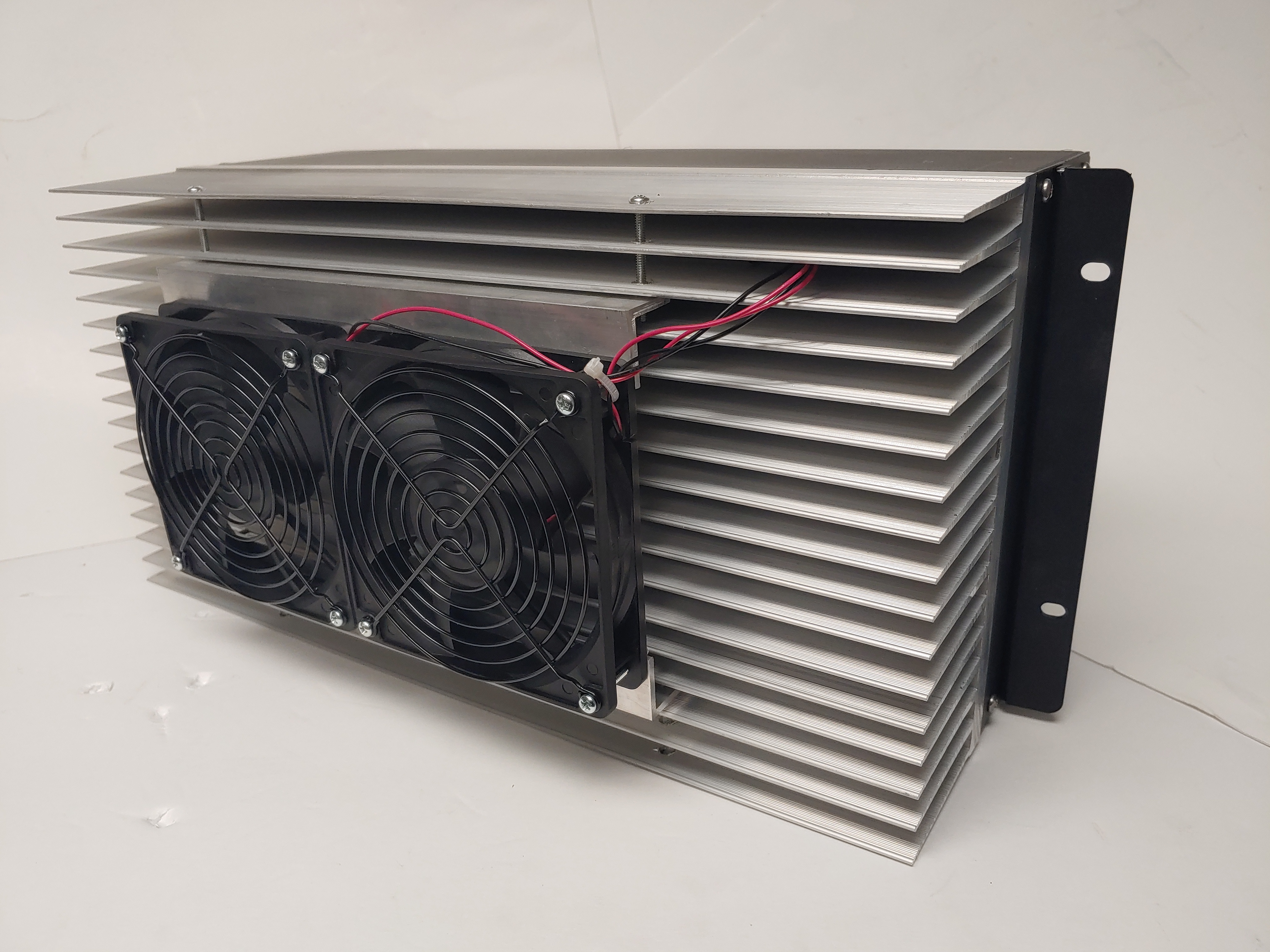
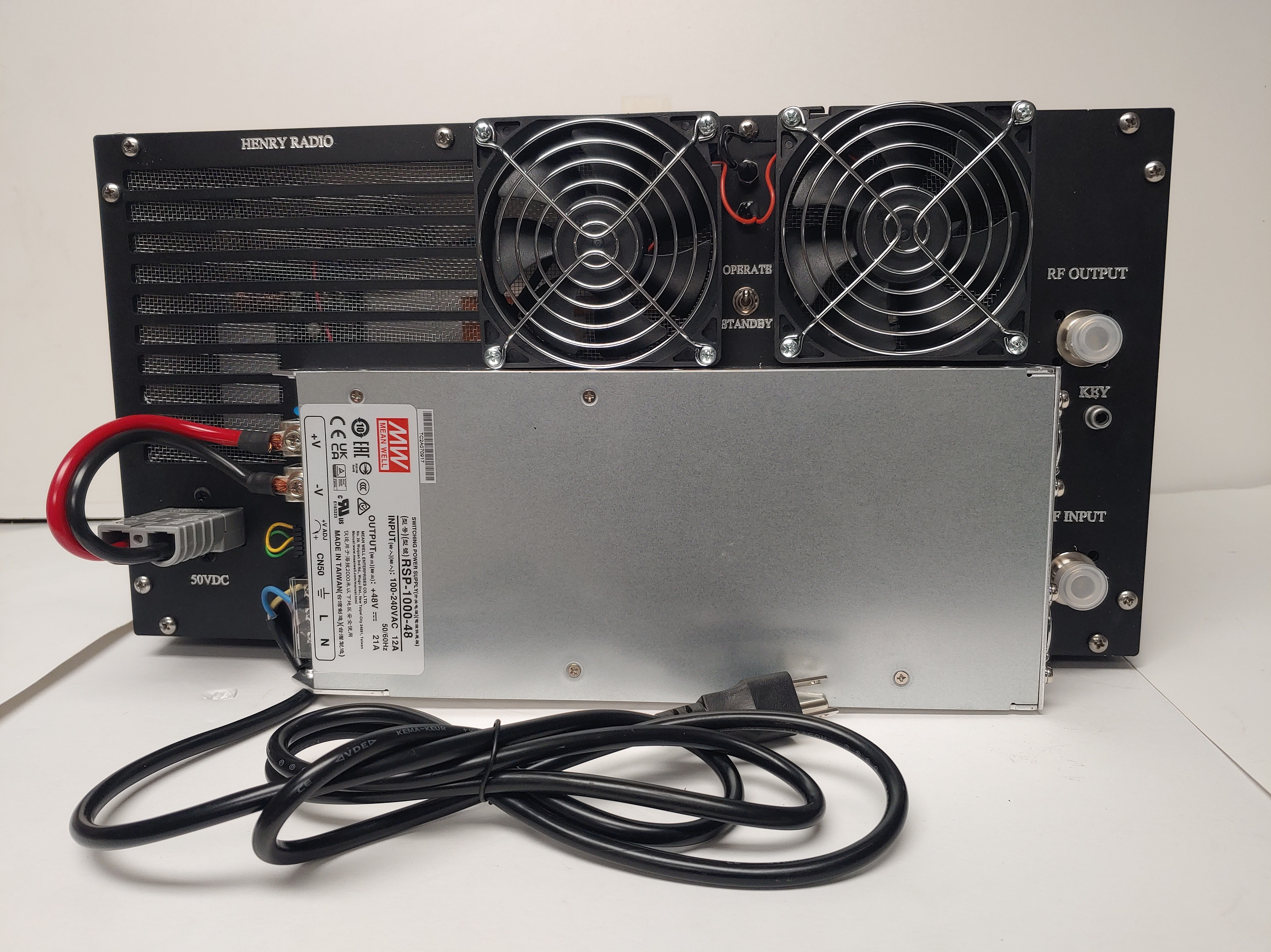
C500 series 300 watt amplifier available for VHF, 222-225 MHz and UHF, occupies 5 Rack Units, (8 3/4 inch). Input is 2-8 watts for 200-500 watts out. 120 / 240V AC power supply is included, delivers 48 volts at up to 21 amps. Photo 1 Photo 2 Each amplifier is custom built to order, specify your input power and frequency with your order. |
|
|
Does anyone have any other Henry amplifier manuals, especially low-band and high-power models? If you have paper we can scan and return. Please contact the page maintainer. |
Technical Articles:
|
|
Converting the Henry Radio C100D10R to
C100D30R by Robert Meister WA1MIK A quick mod allows this UHF amplifier to work with 30 watts input power rather than 5-10 watts. |
|
|
Converting the Henry Radio C300C30R to
6 Meters by John Haserick W1GPO Some variable compression tuning capacitors make all the difference. |
|
|
Another Henry C300C30R Amplifier Conversion
to 6 meters by John Haserick W1GPO Replacing transistors, winding some new coils, and adding variable compression tuning capacitors puts this amp onto 53 MHz. |
|
|
Aligning the Henry Radio 30A02 RF Amplifier by Dr. Carol F. Milazzo, KP4MD (off-site pointer, opens in a new browser tab) |
Power Supply Notes:
|
|
The non-LDMOS amplifiers require 12-15 volts DC and considerable amperage. A VHF, 220 or UHF amplifier in the 100-130 watt class will require about 25-27 amps. Astron rates their RM-35 at 27 amps continuous duty. I wouldn't risk it, especially since most of my sites are at the end of 4x4-only Forest Service roads and it takes from 2 to 3 hours to get there on a good day without snow or freeway traffic. Just to change a fuse can take two people away from the shop for 6 to 7 hours, and it's never just a fuse (something blew that fuse). Several of the site visits have been 12 or more hours inside the building at the site (plus time driving to and from the site). So for a high-duty-cycle 27 amp load I'd use at least an RM-50 and I'd put fans on the heat sinks. Or a Samlex SEC-60BRM. |
|
|
The 250 watt class amplifier will require about 45 amps. An Astron RM-50 is rated for 37 amps continuous so forget that. Astron claims that the RM-60 is good for 50 amps, so that's a possibility, but there's not a lot of headroom and I'd definitely put fans on the heat sinks. The RM-70 is advertised as good for 57 amps, so that's a possibility, however with fans. You can run two of the larger Astrons in parallel for DC and that's good (but you'd want them on separate circuits in the AC mains circuit breaker panel). See this article and pay attention to the details. A Samlex SEC-60BRM would not have enough headroom, I'd probably use a Samlex SEC-80BRM. |
|
|
A 350-500 watt class amplifier typically pulls anywhere from 55 to 80 amps. I'd definitely use a Samlex SEC-100BRM. |
TPL Documentation:
Henry Radio Amplifiers is repairing TPL amplifiers for as long as the parts are available.
TPL Communications is out of business and the building has been sold.
At the annual LMR trade show (IWCE) in 2019 the physical TPL booth was there but not populated
except for a simple printed sign indicating TPL had been sold to Crescend and that you should walk to
the Crescend booth and talk to them for your amplifier needs. (an off-site pointer, opens in a new browser tab)
And that was the last of TPL...
The page maintainer was in the area of the San Fernando Road building a few months after IWCE and
drove by the TPL building.
The TPL sign was gone. Several months later there was a new name on the building.
Prior contact information (only here so that web searches for TPL can find this page):
8160 Van Nuys Blvd, Panorama City, CA 91402
3336 North San Fernando Road, Los Angeles, CA 90065
3370 North San Fernando Road, Los Angeles, CA 90065 (a bigger unit in the same industrial zone)
(800) HI-POWER
(323) 256-3000
(323) 254-3210 (fax)
We (Repeater-Builder) had a number of TPL manuals on our "Other Manufacturers" page.
When Henry Amplifiers acquired the remains of TPL we moved the TPL manuals to this page.
If anyone would like to donate any additional manuals or information please contact the page
maintainer at the link above.
|
|
TPL VHF-Lo Amplifier PA1 series 700 kB PDF file donated by Skipp May |
|
|
TPL VHF-Hi Amplifier PA3 series 490 kB PDF file donated by Skipp May |
|
|
TPL UHF Amplifier PA6 series 590 kB PDF file donated by Skipp May |
|
|
TPL UHF Repeater Amplifier models PA6-1AE, -1BE, -1FE 230 kB PDF file donated by Sal Calabrese N2EHS |
|
|
TPL UHF Repeater Amplifiers 618 kB PDF
file cleaned up by Bob WA1MIK Models RXR, RXRPS, RXRF, RXRF2, RXRFPS, RXRF2PS. This file contains the User's Manual and the Service Manual. |
TE Systems Documentation:
See the Update for March 2026 above and
the eHam posting for the TE Systems story. (an off-site pointer, opens in a new browser tab)
As the Henry Radio Amplifiers people find documents that would be relevant to this page they
will send them to the page maintainer and he will post it.
The initial information below is what was found on the web or arrived in emails.
If anyone would like to donate information please contact the page maintainer at the link above.
Prior contact information (only here so that web searches for TE Systems can find this page):
P.O. Box 25845 Los Angeles 90025
Dave Anderson, David Anderson, K6QDD
(310) 478-0591
(310) 473-4038 (fax)
sales@tesystems.com
|
|
TE Systems UHF Amplifiers (undated) 1.05MB PDF (recovered from the web) (anyone have the VHF page?) |
|
|
TE Systems Price List 1.05MB PDF (recovered from the web) This page contains a model number to input and output power table. (yes, it's from 20 years ago, in October 2005, but it's the only one that we could find on the web) |
|
|
TE Systems 1410G Amplifier 3.52 MB PDF (recovered from the web) |
|
|
TE Systems 1412RRA Amplifier 557 KB PDF contributed by Ray Maynard NØLGR. His email said that: I repaired this amplifier a few years ago, and the 2SC2782 transistors I bought on ebay were apparently knock-offs. I spent considerable time analyzing poor gain from the amp, and finally concluded that the "new" transistors were the problem. After replacing them with a good pair, the amp has been working fine since. I'm sharing this in case anyone on repeater builder encounters a similar issue. |
|
|
TE Systems 4410G Amplifier 5.58 MB PDF (recovered from the web) Mobile SSB amplifier, 10 watts in, 100 watts out. |
|
|
eHam Reviews: TE Systems 1452G (off-site pointer, opens in a new browser tab) Base station amplifier, 20w in, 360 out. VE6MB notes that the TE Systems amplifiers do NOT have overpower-protection on the RF input. He and others have stated that typically they need to be operated at 14 Volts to 14.25 Volts in order to achieve rated output. |
|
|
eHam Reviews: TE Systems 0510RA 6M Repeater
Amplifier (off-site pointer, opens in a new browser tab) Rack mount, 15w in, 170w out. |
|
|
eHam Reviews For: TE Systems 2252RA 220 MHz
HPA Series Repeater Amp (off-site pointer, opens in a new browser tab) Repeater amplifier, 10 watts in, 225 watts out. |
|
|
QST Reviews (January 2012): TE
Systems 1410G (off-site pointer, opens in a new browser tab) Mobile 2 meter FM or SSB amplifier, 4 to 10 watts in, 160 to 200 watts out. |
|
|
QST Compares (October 1996): Three
amplifiers including the TE Systems 1412G (off-site pointer, opens in a new browser tab) Mobile 2 meter amplifier, 30 watts in, 160 watts out, FM or SSB, the tested unit had the optional receive preamp. |
Back to the top of the page
Back to Home
This page initially created 05-Nov-2020.
The information presented in this web site, on these web pages and in these modifications and conversions is © Copyrighted 1995 - current by Kevin Custer W3KKC and multiple originating authors.